

Hello fellow Reluctant Fiduciaries and People Who Have Never Once Considered Trading on Client Information,
The DOJ just charged 30 people in a decade-long insider trading scheme run out of major law firms. Tens of millions. Fugitives in Russia. A Yale Law M&A partner who allegedly logged into his firm’s DMS while officially on leave. As origin stories go, it has excellent fundamentals.
We are not here to tell you how they did it. We are here to remind you of the infinite creativity of the legal mind when pointed in a deeply inadvisable direction — and to ask, loudly, why Congress gets to do basically the same thing as a subscription product.
Let’s get into it. ⚖😂
You are working on a deal. A good one. The kind where you can feel the market-moving event approaching from weeks away, the way farmers feel weather. This is normal. This is the job.
The correct response: bill 14 hours, feel professionally satisfied, go home.
The incorrect response: everything below.
This is where it gets creative. The legal mind, trained to argue both sides, is dangerously good at this. A sampler:
The SEC has a pattern-recognition algorithm running 24 hours a day that specifically looks for trades by people connected to deals. You are a very discoverable shrimp.
At some point the information must travel from your brain to someone who can trade on it without being immediately connected to the deal. This requires an intermediary. The intermediary is always the problem.
In the most recent federal indictment: a Yale M&A lawyer paired with a New York personal injury attorney. This sounds like the setup for a joke. It was the setup for a federal conspiracy charge. The PI lawyer is allegedly how the tips reached the traders. The PI lawyer also apparently kept very detailed records, which is professional of him and catastrophic for everyone else.
Rule of thumb: if your distribution chain requires someone whose practice area has nothing to do with M&A, you have built a liability architecture, not a firewall.
Document management systems log everything. Every file opened. Every search run. Every access, timestamped, attributed, and retained. You cannot tell the DMS you were somewhere else. The DMS knows where you were.
In the recent case, the attorney allegedly accessed confidential deal documents from his former firm’s DMS while officially on leave. The DMS logged it. The DMS waited. The DMS was the most cooperative witness in the entire indictment.
Your document management system is not your colleague. It is a very patient, completely impartial, perfectly organized record-keeper that will describe your entire decade to a federal prosecutor without requiring immunity.
Bill the hours. Close the deal. Watch the stock move from a respectful professional distance. Open a bottle of wine. Call no one. Feel the warm, sustainable glow of someone who still has a bar license and freedom of movement.
That’s it. That’s the cheat sheet. The cheat is: don’t.
| The Lawyer | The Congressperson |
|---|---|
| Trades on material non-public info about a merger | Trades on material non-public info about a defense contract, a drug approval, an antitrust bill they’re writing |
| Federal indictment. Securities fraud. Up to 25 years. Two co-defendants in Russia. | Files disclosure 45 days later. $200 fine if late. No charges. Covered by a $29/month newsletter. |
| Bar license gone. Career over. Legacy: a docket number. | Reelected. Featured on FinTwit. Portfolio up 34% YTD. No comment from spokesperson. |
The law is not a blind scale. It’s a see-saw. Congressional privilege is the fat kid on one end. The rest of us are briefly airborne.
The most cooperative witness in the recent insider trading case wasn’t a person. It was the DMS.
Every document accessed. Every search run. Every timestamp. The system just… kept records. Helpfully. Forever. Legora + NetDocuments gives your deal team AI that works inside your controlled DMS environment — documents never leave, access is permissioned and auditable, and when the subpoena arrives, the logs tell a story of good governance rather than a decade of questionable Tuesdays.
Your logs are already being written. The question is who controls them.
Investment Objective: Replicate the investment performance of sitting U.S. legislators based on public STOCK Act disclosures. All data is public. All trades are legal. We are simply aggregating them into a convenient index. Nobody is alleging anything.
Core Holdings: Defense contractors purchased before classified briefings. Pharmaceutical positions established ahead of FDA committee votes. Technology stocks traded the week before antitrust markup sessions. Healthcare funds acquired prior to pandemic preparedness briefings. Nothing to see here. These are disclosures.
Risk Factors: Congress could theoretically enforce the STOCK Act. Congress could theoretically vote to prohibit its own members from trading individual stocks. Congress could theoretically feel shame. Investors should model all three scenarios as negligible tail risks.
The 0.85% expense ratio funds the legal team retained to explain, at conferences and in newsletters, that following public disclosures is not insider trading, no matter how much it smells like it from downwind.
We haven’t just failed to stop insider trading in Congress. We’ve industrialized it. We’ve built dashboards, subscription tiers, and premium alert notifications for it. The scandal became a sector. The sector is growing. The cancellation rate is below 8%.
The lawyer who acts on the same information goes to federal prison. The legislator who acts on infinitely better information goes on FinTwit. This is the system working as designed. The design is the problem.
Walter, Editor-in-Law
When you write the rules, the first one you write is: “What’s mine is mine, and what’s yours is also potentially mine, depending on the committee markup.”
P.S. To the sites running congressional stock trackers: magnificent bastards. You saw a leaking ethical sewer and built a bottled water company downstream. Godspeed.
P.P.S. To retail investors following these lists: you’re not beating the market. You’re just helping validate a broken one. Hope the returns are worth the moral cost of admission.
P.P.P.S. Forward this to the deal team member absolutely using consumer AI for due diligence and has told no one about it. The AI logs exist. They are timestamped. Consider this their heads-up.
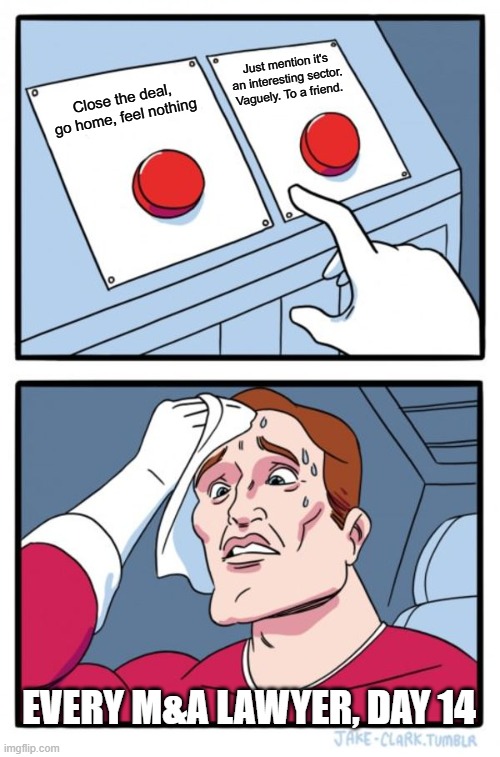
Best Step 2 rationalization you’ve ever heard from a colleague? Anonymous submissions open. No timestamps. No bar referrals. Research purposes only.
Forward this to the partner who called the STOCK Act “basically fine.” They’ll appreciate the GRAFT fund prospectus.