Hello fellow Billboard Enjoyers and Holders of Actual Bar Cards,
Somewhere on a highway near you, a personal injury attorney is smiling down at traffic from sixty feet in the air, promising results that state bar rules technically forbid him from promising. Meanwhile, the firm handling your company’s $4 billion merger has never once run an ad, because it has decided that dignity is the brand. This week: what happens when those two universes collide.
Let’s get into it! ⚖😂
If it feels like there are more lawyer billboards on your commute than there were five years ago, that is not a vibe, that is a budget line. Legal services spent roughly $650 million on outdoor advertising last year, more than double what they spent in 2021 and up 260% since 2017 — enough to outspend hospitals, the No. 2 industry on the list. And it was all illegal until 1977, when the Supreme Court struck down a state ban on attorney advertising and, in doing so, invented the entire billboard-lawyer industrial complex as an act of constitutional accident.
No firm has leaned into this harder, or more successfully, than Morgan & Morgan. It figured out earlier than anyone that a law firm could be a national consumer brand instead of a law firm, and it built “Size Matters” into a household phrase without ever once explaining what, specifically, is bigger. Above the Law recently pointed out that whatever you think of the strategy, it has permanently changed how the entire profession thinks about marketing, and it is currently pushing the boundary further: the firm is suing the Florida Bar over a rule that bans lawyers from using a celebrity’s image or voice in ads, naming Shaquille O’Neal, Frankie Muniz, and John Daly in the complaint as evidence of what it can no longer do. None of the three, as far as public record shows, has ever filed a complaint on Morgan & Morgan letterhead.
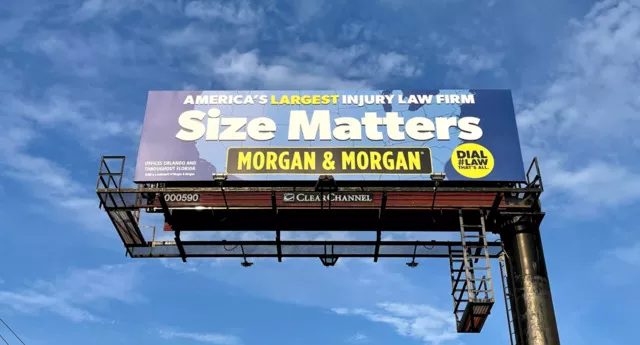
Exhibit: an actual billboard, existing in the actual world, unbothered.
This raised an uncomfortable question in the group chat. If a plaintiff’s firm can put “Size Matters” sixty feet in the air with zero shame, what is stopping the firm that bills $2,200 an hour to draft a merger agreement? Nothing, legally. Norms, mostly. We removed the norms. Here is what we found.
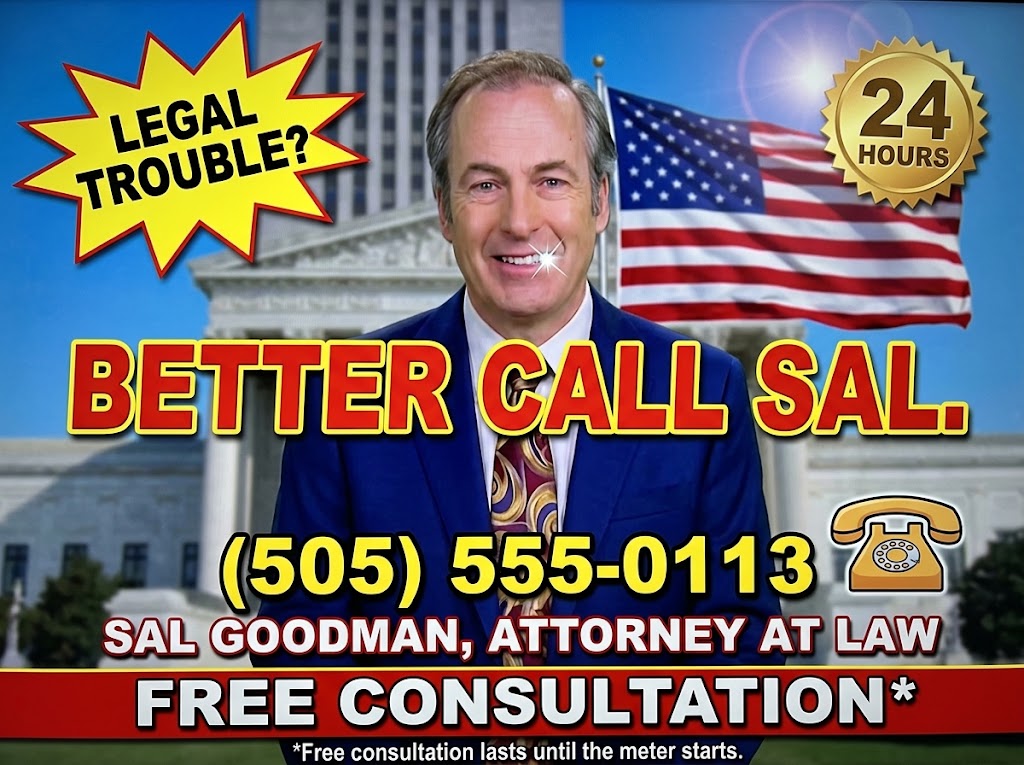
Not a real attorney. Extremely real energy. (Deep dive on the source material in Popcorn Jurisdiction, Issue #30.)
Before Morgan & Morgan made billboard lawyering a national brand, television had already run the experiment as satire and the public simply did not clock the joke. The gold tooth, the “24 hours,” the free consultation that is free right up until the meter physically starts, the flag waving behind a suit that has never once been to court: this is not parody anymore, it is a template, and half the firms on this list are running it with better production values and a bigger media buy. The line between “fictional cautionary tale” and “current market leader” is thinner than anyone in law school ethics class wants to admit.
Nine firms. Nine ad campaigns nobody at these firms authorized, commissioned, or has ever seen. We think they should exist anyway.
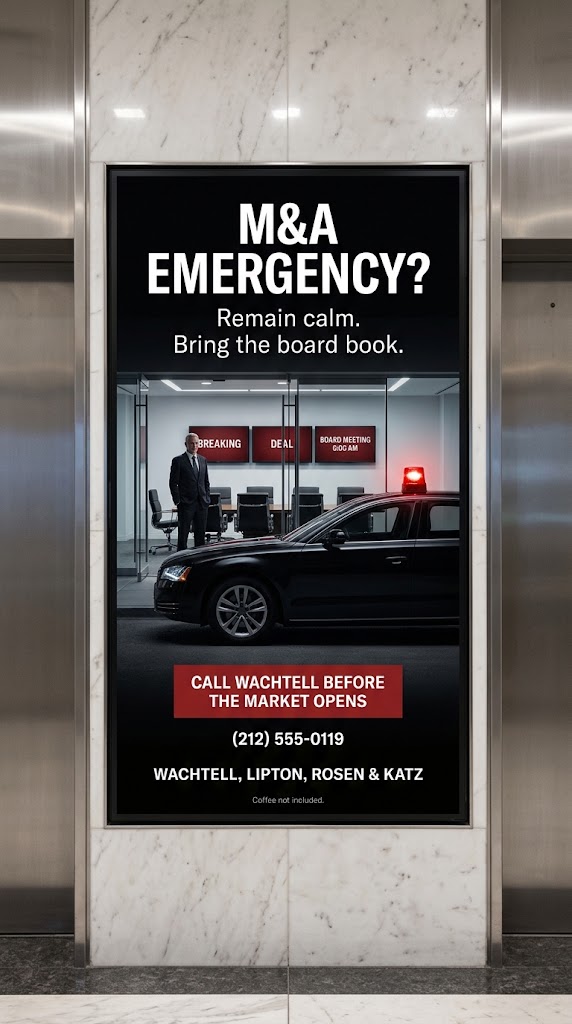
| The Pitch: | “M&A Emergency? Remain calm. Bring the board book.” Deployed, naturally, in the one place a stressed general counsel is guaranteed to stand still for eight seconds: the elevator. |
| Why It Works: | Wachtell famously does not advertise, does not do lateral partner hires, and has never needed a tagline because its per-partner profits do the talking. An actual Wachtell billboard would therefore be the most alarming thing a general counsel sees all year, which is exactly the emotional register this firm has built its practice on. |
| Verdict: | ⚖ Sustained. The blacked-out sedan and the flashing light sell the one service this firm actually provides: making you believe your Tuesday just became a crisis. |
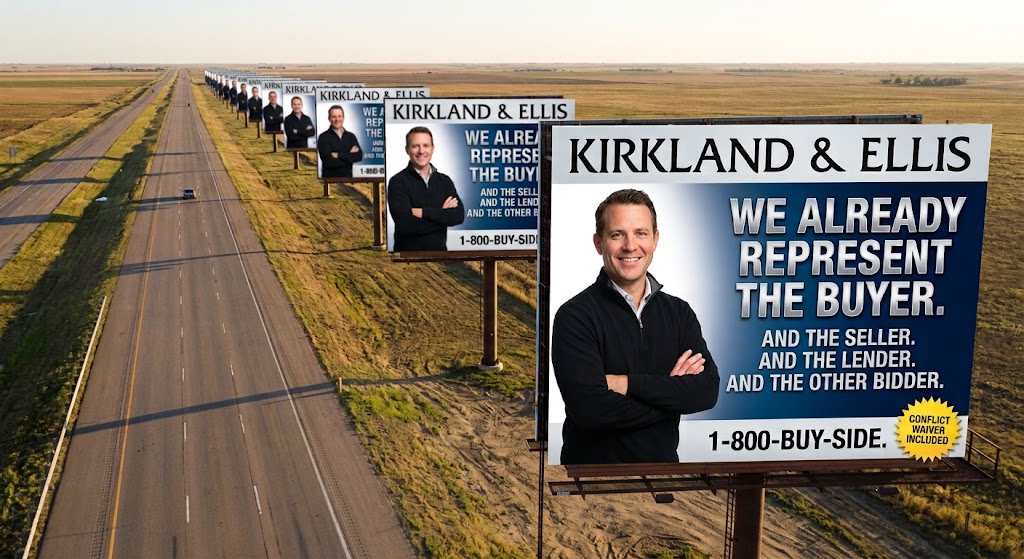
| The Pitch: | “We already represent the buyer. And the seller. And the lender. And the other bidder. 1-800-BUY-SIDE.” Repeated, identically, on every billboard for the next eleven miles. |
| Why It Works: | The world’s largest law firm by revenue does not need to explain its reach, it needs you to physically experience it, one identical billboard at a time, until you accept that there is no deal in America this firm is not already somewhere inside of. |
| The Fine Print: | “Conflict waiver included” is doing more legal work in six words than most firms’ entire engagement letter. |
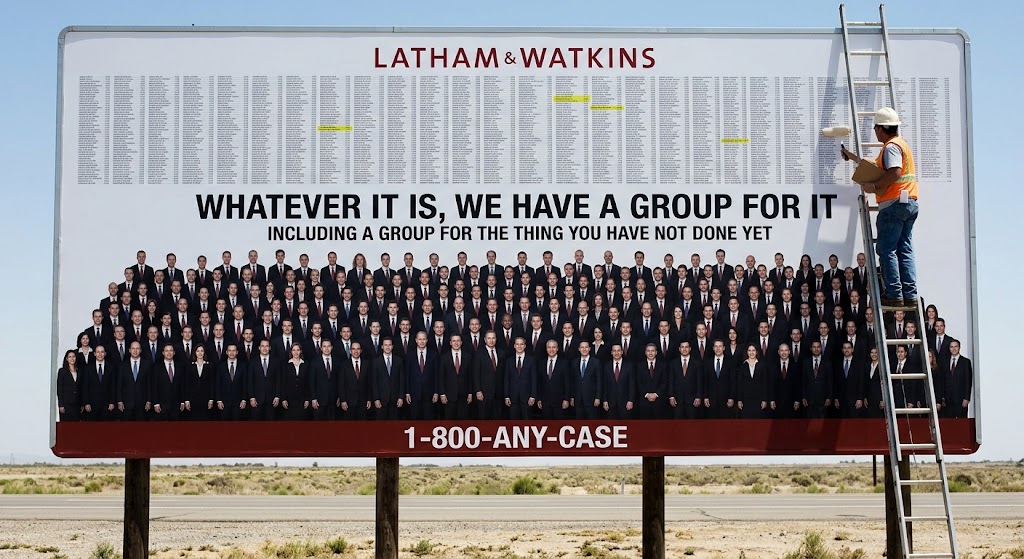
| The Pitch: | “Whatever it is, we have a group for it. Including a group for the thing you have not done yet.” Illustrated by roughly two hundred lawyers standing in formation, because that is fewer than are actually on staff. |
| Why It Works: | At Latham’s scale, the sales pitch stops being about skill and starts being about inventory. Somewhere in that headshot pyramid is a practice group for a regulatory problem that will not exist until 2031, and they are already staffed for it. |
| Verdict: | ⚖ Sustained. The painter touching up the sign in real time is the most honest detail in this entire issue — the roster changes faster than the billboard can be printed. |
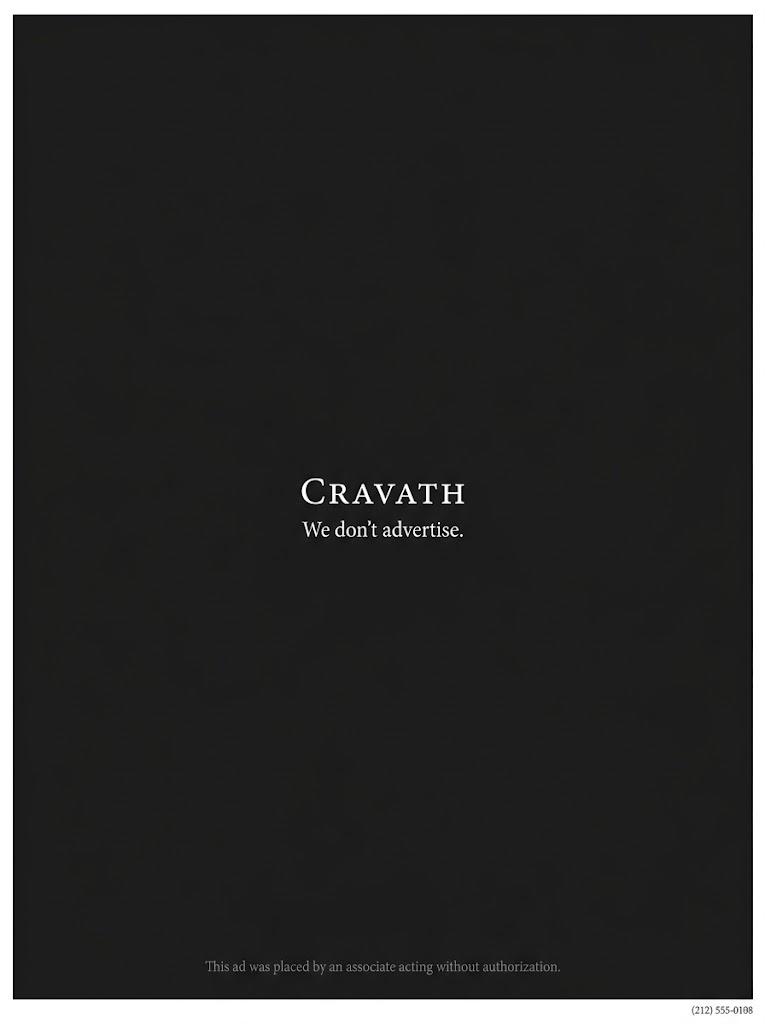
| The Pitch: | An all-black magazine page. Small serif type. “Cravath. We don’t advertise.” Below it, in smaller type still: “This ad was placed by an associate acting without authorization.” |
| Why It Works: | Cravath has spent over a century building a reputation on the idea that it does not need to be sold to anyone, which is precisely why the funniest possible version of a Cravath ad is one that technically should not exist. |
| Outcome: | The associate responsible is currently drafting a very long memo explaining their billing entries for the week this ran. It will not mention the ad. |
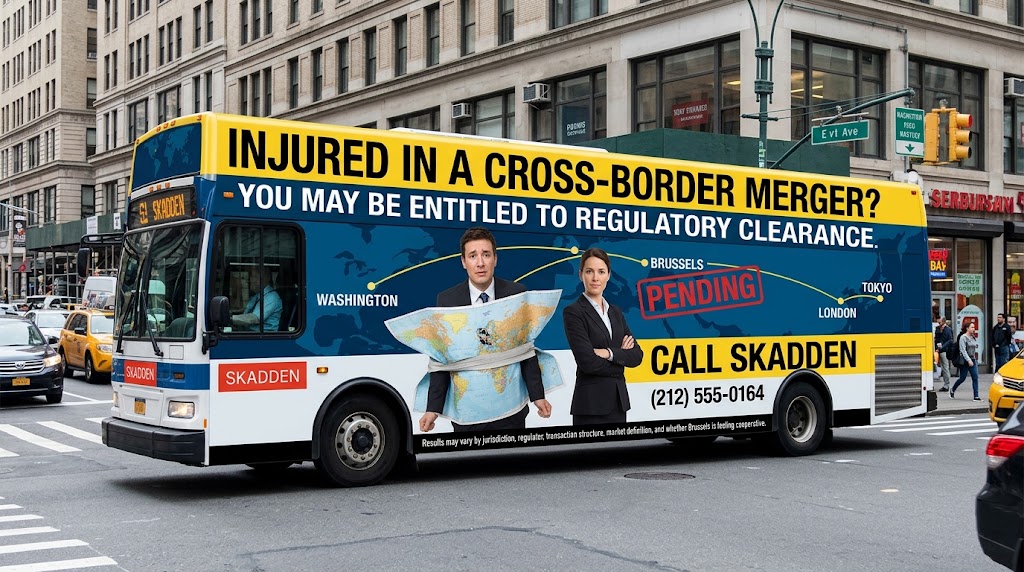
| The Pitch: | “Injured in a cross-border merger? You may be entitled to regulatory clearance.” Wrapped around an entire city bus, in the exact font a settlement mill uses for “you may be entitled to compensation.” |
| Why It Works: | Global antitrust practice is, structurally, a personal injury case: something bad happened across several jurisdictions, nobody agrees on liability, and it takes eighteen months and a specialist to make it go away. |
| The Fine Print: | “Results may vary by jurisdiction, regulator, transaction structure, market definition, and whether Brussels is feeling cooperative” is, unfortunately, an entirely accurate disclosure. |
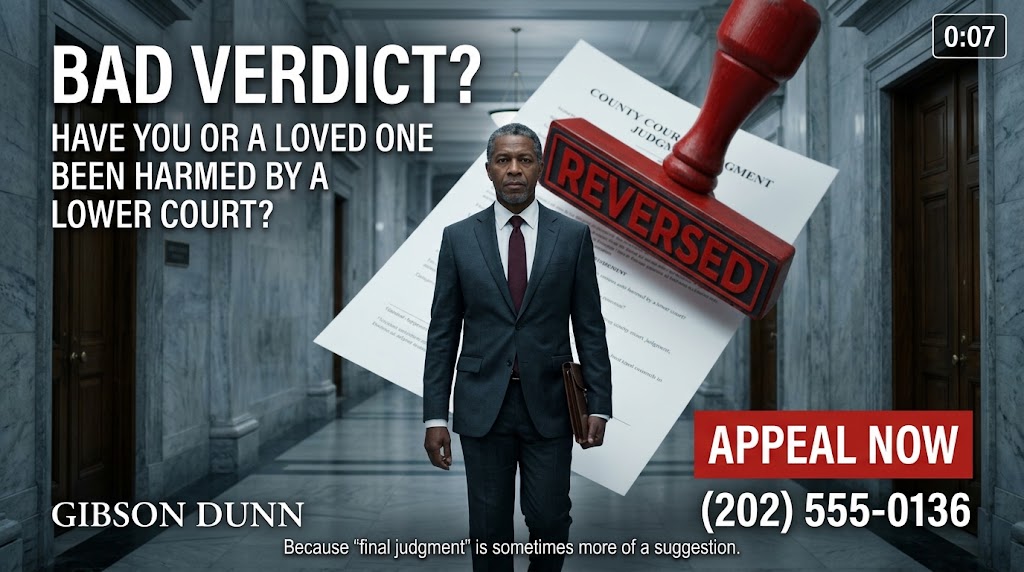
| The Pitch: | “Bad verdict? Have you or a loved one been harmed by a lower court? Appeal now.” A countdown timer in the corner. A rubber stamp mid-swing that reads REVERSED. |
| Why It Works: | Appellate practice is the one BigLaw specialty that is genuinely, structurally a rescue mission: something already went wrong, the clock is running, and you need someone who has argued in front of the people who get to say “never mind.” |
| Verdict: | ⚖ Sustained. “‘Final judgment’ is sometimes more of a suggestion” may be the single most honest thing anyone has printed on an advertisement this year. |
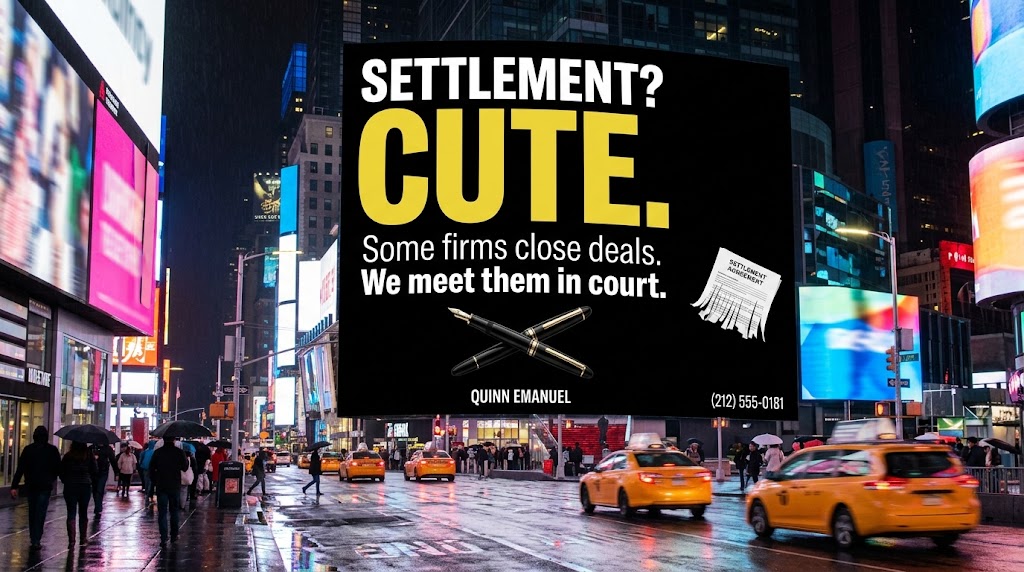
| The Pitch: | “Settlement? Cute. Some firms close deals. We meet them in court.” Yellow on black, Times Square, no photo of a smiling attorney required. |
| Why It Works: | This is the one firm on the list with zero transactional practice and a genuine institutional allergy to walking away from a fight, so the confrontational billboard is not a marketing choice, it is a deposition. |
| Outcome: | The crossed fountain pens under the shredded settlement agreement are doing more character work than most law firm mission statements manage in three paragraphs. |
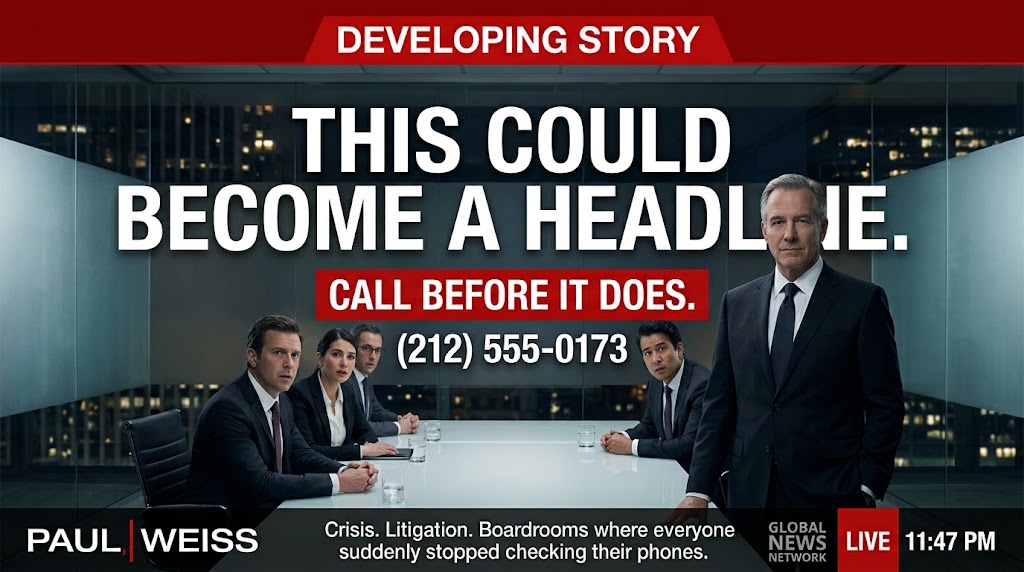
| The Pitch: | A fake breaking-news chyron: “This could become a headline. Call before it does.” A conference table full of people who have all, simultaneously, stopped checking their phones. |
| Why It Works: | Crisis and litigation work is sold on timing, not talent. The entire pitch is “call us before the story breaks, not after,” and nothing communicates urgency like a chyron that already assumes the headline is coming. |
| Verdict: | ⚖ Sustained. The scrolling ticker at the bottom reading “Boardrooms where everyone suddenly stopped checking their phones” is, unfortunately, a documentary description of most Monday mornings in BigLaw. |
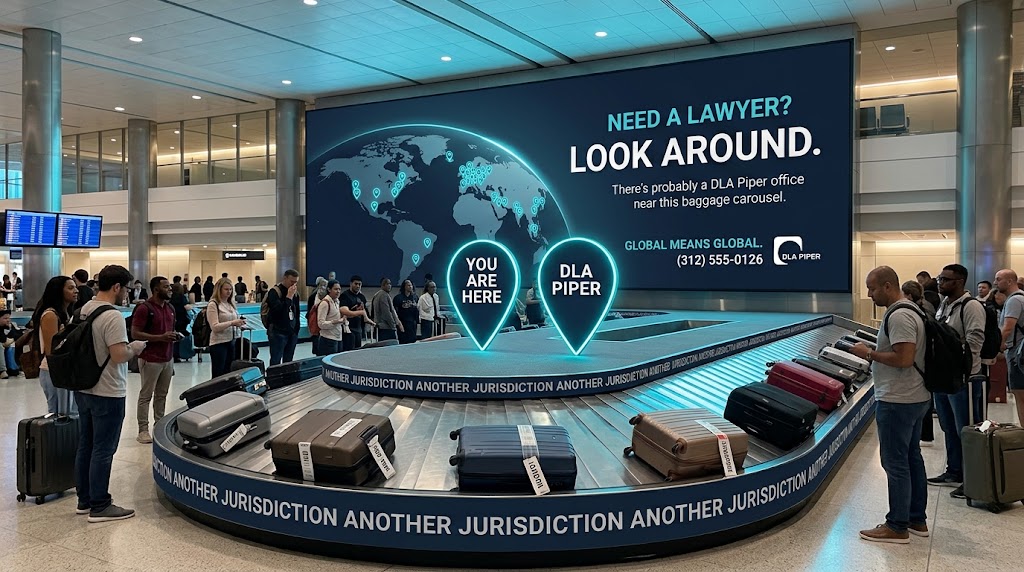
| The Pitch: | “Need a lawyer? Look around. There’s probably a DLA Piper office near this baggage carousel.” Placed directly above the actual baggage carousel, for maximum documentary accuracy. |
| Why It Works: | DLA Piper is, by office count, functionally a country. This is less an advertisement than a public service announcement for people who did not realize they had already re-entered its jurisdiction. |
| Outcome: | “Global means global” is the rare tagline that is not exaggerating. |
| The BigLaw Partner: | “This is beneath us.” Forwards it to the entire practice group with the subject line “lol.” Secretly screenshots the Kirkland one for the retreat deck. |
| The PI Attorney: | Reads this, nods slowly, and asks their marketing agency why their firm doesn’t have a fountain pen prop yet. |
| The GC: | Forwards the Wachtell mockup to outside counsel with no comment. Outside counsel does not know if this is a joke or a retention question. |
| The BigLaw Marketing Department: | Has already opened a shared doc titled “billboard concepts – DO NOT SEND TO PARTNERS YET.” |
Every firm on this list already runs the Morgan & Morgan playbook, they just do it in a tombstone ad, a law school recruiting brochure, or a rankings submission instead of a billboard. The size claim, the urgency, the implied promise of an outcome nobody can actually guarantee — it is all there, just wearing a better suit and billing by the hour instead of the contingency.
The only real difference between Morgan & Morgan and the AmLaw 100 is where the ego gets displayed: sixty feet above I-95, or two lines into a partner biography that says “widely regarded as one of the foremost practitioners in the field.” Widely regarded by whom is, as always, left as an exercise for the reader.
Bill the time spent reading this to “competitive intelligence.” You are, technically, gathering it.
Walter, Editor-in-Law
My billboard would just say “objection” in forty-foot letters and let the market figure out why.
P.S. None of the nine campaigns above are real. Kirkland, Latham, Wachtell, Cravath, Skadden, Gibson Dunn, Quinn Emanuel, Paul Weiss, and DLA Piper did not commission, approve, or see any of this coming. If any of you would like to actually run one, our rates are extremely reasonable.
Seen a real lawyer billboard that beats anything in this issue? Send a photo. We will not editorialize. We will not need to.
Share with 3 colleagues who have strong opinions about the Kirkland billboard and 1 opposing counsel who is, right now, driving past an actual version of one of these.